Dr. Philip McMillan, John McMillan
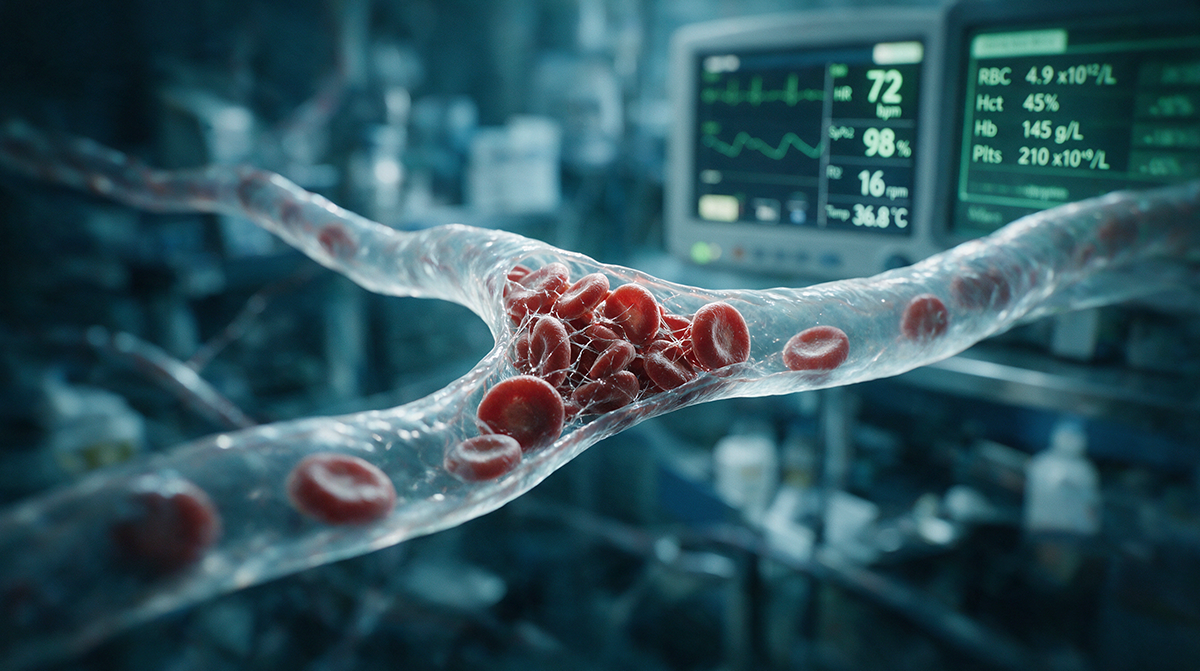
Somewhere in your body, in vessels far too small to feel, blood may be moving through channels that are quietly closing. Not the dramatic clot that fells a person in an hour — the kind that arrives with chest pain and screaming sirens. Something smaller, slower, and far harder to catch. This is the territory a small group of researchers has spent more than six years mapping, and their conclusion is disconcerting. Damage is real, it is common, and most of it is happening in places no routine test is looking.
The Quietest Place in the Body
The setting for the story is the microcirculation, the vast web of capillaries that ferries oxygen to every tissue of the body. Dr Beate Jaeger, a German laboratory physician who has treated clotting and lipid disorders for three decades, calls it a playground of roughly seven thousand square metres of inner vessel lining. That is where a spike protein, the fragment of Covid 19 virus that so many people now carry in trace amounts, appears to do its quietest work. In her most affected patients, the readings are startling. Venous oxygen saturation that should sit near seventy per cent instead comes back at fifteen, sometimes eleven. Blue lips. Blue feet. Wasting muscles. One of her early patients, a strong manual worker from Dortmund, lost thirty kilograms in two months and arrived at her clinic unable to walk on his own.
Jaeger’s research partner, Joachim Gerlach, an entrepreneur and engineer turned self-taught systems biologist, describes two separate failures happening at once. The first is structural. The tiny vessels themselves become inflamed, break down, and die off, a process called capillary rarefaction. The second is functional. The pipes are still there, but the flow through them is choked. Blood cells stiffen and struggle to squeeze through channels barely wider than themselves. Fibrin, platelets, and amyloid deposits form microscopic clots. Tiny muscular valves at the mouth of each capillary, the precapillary sphincters, clamp shut when spike protein drifts near. Imagine the water main to a house working perfectly while every tap inside slowly clogs up. The organs downstream are starved even if the plumbing is intact.
Why It Slips Through the Net
Gerlach is blunt about why so many patients are dismissed by health authorities. “It is one of the most complex multisystemic diseases in medical history,” he says, and that complexity is precisely what makes it slip through the net. A conventional blood panel comes back unremarkable. The cardiologist finds a normal heart on the usual scans. The patient is tired, breathless, and frightened, and is quietly filed under anxiety or ageing. The team argues this is not one illness but a spectrum, and it has built a five-tier severity scale to describe it. At one end sits the person who is spike-positive and feels fine. At the other sits the patient who arrives in a wheelchair. Most people, they suspect, are somewhere on that ladder without knowing they are on it at all.
Think of the elderly for a moment. An independent eighty-year-old, already carrying a little fatigue and a few chronic aches, picks up an infection so mild it registers as a bad afternoon. Weeks later their energy is gone and their ability to walk declines, until one day they are housebound. Nobody connects these events, because elapsed time obscures the cause. This delay, sometimes two or three weeks, sometimes a decade, is what makes the whole pattern so easy to miss and so easy to deny.
Filtering the Blood, and What Comes First
For the sickest patients, Jaeger reaches for a procedure most people have never heard of, called HELP apheresis Heparin-mediated Extracorporeal Lipoprotein/fibrinogen Precipitation. The name is a mouthful, but the idea is clean. Blood is drawn out, filtered through a circuit rich in unfractionated heparin, and returned. The filter binds spike protein, strips out viral genetic material, drops fibrinogen by around seventy per cent, and dissolves microthrombi. In one striking case, a violinist from Frankfurt with heart inflammation had venous oxygen of just sixteen per cent. Two hours after treatment it had climbed to eighty-six. Jaeger even describes saving her own mother from amputation: four toes turned black overnight, and she reversed the damage in two or three sessions. These stories are dramatic, and she is the first to say the treatment is costly, scarce, and out of reach for almost everyone who might need it.
That scarcity is where her frustration boils over, and where her most practical message lives. Apheresis will never reach every clinic on earth. Simple drugs already can. “The use of heparin should be available in the entire world, as is the use of baby aspirin available around the whole world,” she says. Her wider protocol starts with restoring depleted vitamins and trace elements, then adds antiplatelet agents such as aspirin and clopidogrel, anticoagulants like heparin, antihistamines, and antivirals, escalating to apheresis only when everything else fails. Gerlach’s group is working on natural compounds reformulated to sit alongside these medicines rather than replace them. Nobody is promising that a supplement lifts a patient out of a wheelchair. The point is earlier, cheaper, wider intervention, because stopping the damage is far easier than reversing it.
The Bill Arrives Long After
Why does reversing it matter so much? Because some of it cannot be undone. When capillaries feeding irreplaceable tissue die, the neurons or heart muscle they served can go with them. Fibrosis sets in, and even stem-cell therapy, Gerlach suspects, will not bring those cells back. The clearest way to grasp the stakes is an analogy Dr Philip McMillan offers from cardiology. For years, high blood pressure was called essential hypertension and simply watched, because doctors did not yet understand it as a disease. Treat a patient after ten silent years and the damage to heart, kidney, eye, and brain is already carved in. The team fears the microclotting story is unfolding the same way, year on year, with the bill arriving long after the infection is forgotten.
Their numbers, still awaiting peer review, are meant to raise the alarm. Across more than nine thousand blood samples, they report detectable spike protein climbing sharply, from roughly forty per cent of samples to nearly ninety over a single year. If that holds, it suggests a slow, constant drip of inflammatory material reaching the vessel lining in people who feel perfectly well. The researchers also raise pointed questions about viral origin and about repeated exposure through both infection and vaccination — territory that remains contested and deserves careful scrutiny. What is harder to wave away is the clinical shadow they point to: rising myocardial infarctions in the young, more aneurysms, more hernias, more wounds that fail to heal after surgery.
So what is a reasonable person to make of all this? Not panic, and not dismissal either. The honest position sits in the uncomfortable middle, where the science is unfinished but the signal is too consistent to ignore. The greatest danger, in this telling, is not the clotting itself but the silence around it — a medical community exhausted by COVID, a public desperate to move on. A quiet problem that nobody names does not stop being a problem. It simply keeps working, vessel by vessel, out of sight.

Thank you for all you do Dr McMillan
Thank you Dr McMillan! I am wondering if this is happening to my husband. We did not take the shot. We both had Omicron and had monoclonal antibodies (Regeneron) Slowly over time my husband is short of breath since infection. I use the oxymiter to measure when he’s out of breath. It can be 87 or has been as low as 50. Very scary. All medical tests are normal. I have also wondered about the glycocalyx test. You can’t find anyone who does it or even understands what it is. Unbelievable…….
We live in Pittsburgh. Any and all innovation here is at the University of Pitt in vaccines and more pharma.
Hi Donna,
(unvaxxed) I had my antibodies against Covid measured in January 3. It was 1.437 BAU, which is far too high.
The green zone is 0-200 according to some, e.g the World Council of Health, 0-385 according to others. Anything above a 1.000 needs attention.
I took Pine needle shoot extract, dandelion root extract and Huaier mushroom, and on the 1rst of July I was down to 620.
Maybe that is a way foward for your husband to prevent further damage?