Dr. Philip McMillan, John McMillan
By 2023, it was no longer in dispute that the mRNA COVID vaccines could inflame the heart. Myocarditis, an inflammation of the heart muscle, had been logged as a recognized side effect that turned up most often in younger men, and the reassurance that came with it was always the same single word: rare. A team of Japanese researchers set out to test what that word might be hiding, and they already had the ideal tool waiting for them in the hospital.
The Scanner Was Already On
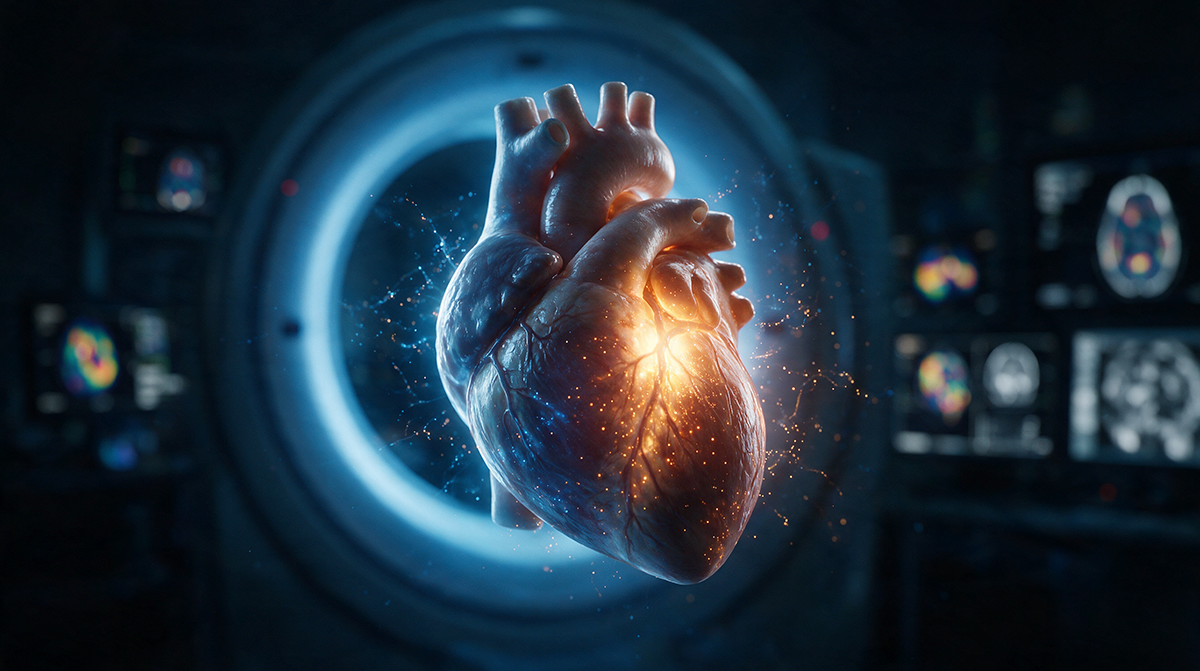
That tool was the PET scan. These scans track how tissue takes up labelled glucose (fluorodeoxyglucose) in order to identify hot spots suggestive of cancer. Inflamed tissue is greedy for it as well and an inflamed heart, in other words, lights up on this kind of scan. Plenty of patients were coming through for these scans anyway, for cancer checks and other reasons that had nothing to do with their hearts. Since the scanner was already switched on, and since possible inflammation reveals itself through glucose uptake, the researchers asked a simple question: why not compare the hearts of vaccinated people against those who had never been vaccinated, and see whether anything was quietly going on? If a symptomless version of that heart inflammation was there, the scan would catch it. What they saw was strange enough that it should have started a conversation. Instead, the signal went quiet.
The finding was published in the journal Radiology. It compared asymptomatic people who had received an mRNA COVID vaccine against those who had not. In the vaccinated group, a striking number of hearts were lighting up with glucose uptake in places, and to a degree, that the unvaccinated hearts were not. To understand why that matters, you have to understand how a heart actually keeps itself running.
Why the Heart Runs on Fat
The heart is the one muscle that never gets to clock off. It beats every second of every day, which means it cannot afford to be wasteful with fuel. For that reason it runs mostly on free fatty acids rather than sugar. Fat yields more energy per unit than carbohydrate does, so a healthy heart leans on it heavily, sometimes drawing as much as 90 percent of its energy from fat when the body is at rest and blood sugar is low. After a meal, when glucose is high, the balance tips a little toward carbohydrate. There is always some overlap. But the general rule holds: a heart burning fat is a heart getting the most out of every beat.
A heart that has swung toward burning glucose is running on the lower-yield fuel. And that is close to what the scans appeared to show in the vaccinated cohort. One image the researchers highlighted came from a 38-year-old man with no diagnosed myocarditis at all. He was simply in the scanner for something else. His left ventricle was taking up glucose in a way that looked nothing like the quiet, normal uptake seen in unvaccinated men decades older.
Severe myocarditis, the kind that lands someone in hospital or worse, genuinely is uncommon. But rare severe disease is not the same as a rare underlying change. You cannot count what you never measure.
“That doesn’t mean it’s rare to have subclinical myocarditis because you don’t know if you don’t look for it,” said Dr. Philip McMillan, the British physician and researcher who has spent years drawing attention to this study.
Who Would Feel It First
Picture elite tennis. A player who can grind through five sets at nearly 40, the way Novak Djokovic has, is running a heart that burns fat cleanly and holds its output deep into the fourth hour. A younger player whose heart leans more on glucose may fade sooner, feeling the fatigue earlier, because sugar simply cannot match fat for energy return. Most people who spend their days at a desk would never notice a shift like this. But the marathon runner, the professional athlete, the person who drives a heart to its limit, that is who would feel it first. It would not be surprising, in the coming years, to hear more high-level athletes describing exactly this kind of unexplained drop in stamina.
The scans turned up one more curiosity. Close to a fifth of patients showed swollen lymph nodes after vaccination, and the researchers noted increased uptake in the axillary nodes, under the arm. Whether that points to a broader inflammatory response or something else, no one has said. It is the sort of loose thread that good science is supposed to pull.
None of this proves what is causing the glucose shift. The obvious guess is inflammation, low-grade myocarditis flying under the radar. But the cause may matter less than the plain fact of the change. Something about the heart’s energy handling looks different after vaccination, and the heart is not an organ anyone should be relaxed about disturbing.
A Pattern Across Millions
The single scan is one thing. A whole population is another. Working with a system able to sift through roughly 186 million data points across the United Kingdom, the same pattern surfaces. Acute myocarditis, rising. Heart failure, climbing since 2020 and still climbing. Heart block, up. No single person is destined to develop any of it, and most people, going about ordinary days, would feel nothing. But a trend across millions is not noise, and it is not something you can shrug off as coincidence.
If this 2023 study is as unusual as it looks, why has almost no one followed it? A quick check of Google Scholar tells the story: somewhere around 38 citations since publication. For a finding this odd, that number should be in the hundreds, maybe the thousands, with teams around the world trying to confirm it, refute it, or explain it. The near-silence suggests the scientific community has decided not to look. There is a gentler reading, that researchers glanced at the paper and dismissed it over technical quibbles about matched cohorts. There is a darker one, that someone did look, did not like what they found, and quietly filed it away. Neither is comforting.
So what is a person supposed to do with all of this?
“Your blood pressure is your responsibility. What I’ll say to you now is your outcomes are going to be your responsibility. You better start asking questions,” Dr. Philip McMillan told his audience.
That is not a counsel of despair. It is a call to stay informed and to keep asking, because the reach of any single voice raising these concerns can be, and has been, cut down. The population data will not explain itself. Those 38 citations will not multiply on their own. If there are scientists or clinicians reading who have the means to test this signal, the most useful thing they could do is study it, publish it, and force the follow-up that should have happened two years ago. And for everyone else, the task is simpler and harder at once: get educated, stay prepared, and do not assume someone else is going to ask the question for you.


I remember that you covered this!
Thank you, Dr. McMillan!