Dr. Philip McMillan, John McMillan
A new Science Advances paper shows the virus triggers an infected cell to make a protein that prompts nearby immune cells to build their own infection doors. An already approved drug blocked it in mice. Dr Philip McMillan argues the finding matters most for what happens after a mild infection.
Every virus shares the same weakness. It owns no machinery of its own, so it can do nothing at all until it gets inside a cell, hijacks the protein factory, runs off copies of itself and moves on. Keep it out and it is inert.
SARS-CoV-2 carries a key, the spike protein, and the lock it fits best is a receptor called ACE2, which sits in abundance across the lungs and upper airway. Which cells carry which locks decides where the virus can travel. For most of the pandemic, that was the working picture: a key, a lock, and a map of vulnerable tissue.
A study published in Science Advances on September 18 unsettles it. The virus does not only find locks. It can talk a cell into fitting more of them, and the cells it talks into it are the ones dispatched to destroy it.
The Protein That Hands Out Keys
Alongside its structural parts, SARS-CoV-2 manufactures a set of accessory proteins whose jobs are still being worked out. One of them is ORF8, named for the open reading frame of genetic code that produces it. Infected cells secrete it, so it travels well beyond the cell that made it.
Yusuke Matsui and colleagues found that ORF8 latches onto a receptor called IL-17RA on the surface of macrophages, the big scavenging immune cells that patrol the lung and swallow pathogens. Once ORF8 binds, the macrophage responds by displaying more ACE2. The cell sent to eat the virus starts building the very doorway the virus needs.
What follows is grim. These newly receptive macrophages get infected, lose their antiviral grip and die by pyroptosis, a messy inflammatory form of cell death that bursts the cell open and spills alarm signals into the surrounding tissue. Inflammation climbs. And when the researchers grew macrophages alongside alveolar type II cells, the delicate cells lining the air sacs, infection of those lung cells took off in a way it had not before. The macrophage had become an accomplice, and the loop fed itself: more infection, more inflammation, more infection.
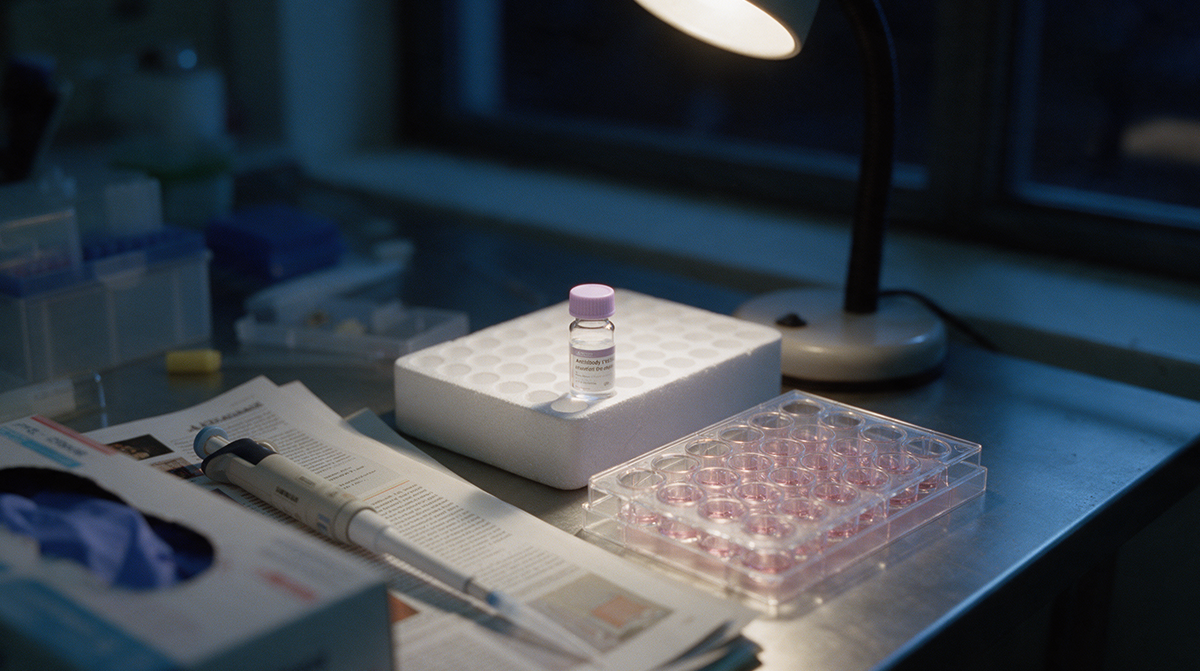
Then comes the turn that makes this more than a cautionary tale. If ORF8 works through IL-17RA, blocking that receptor should break the circuit, and drugs that do precisely this already exist. The team tested brodalumab, an antibody licensed for psoriasis, in infected mice, and saw virus levels, lung inflammation and scarring all fall. The authors are careful about what that means. Mice are not people, and whether the same move helps someone with severe COVID remains an open question.
A Second Door
ORF8 is not the only route in. In February, a team writing in Signal Transduction and Targeted Therapy described something structurally similar working through a different receptor, CD147, also known as basigin.
In rhesus macaques, they found that infection activates a transcription factor called the aryl hydrocarbon receptor, which switches on the CD147 gene and raises CD147 protein levels while membrane-bound ACE2 goes down. They then solved the structure of CD147 bound to spike using cryo-electron microscopy, pinned down five pairs of interacting residues, and showed that an antibody called meplazumab could jam the connection. Severe disease, by a path that does not need ACE2 at all.
McMillan, who had presented on CD147 before, draws out the principle rather than the detail. He had assumed the virus would push ACE2 down. It may be doing both at once, raising one lock here and another there, depending on the cell. Two papers, two receptors, one habit: the virus gets cells to manufacture more of what it needs.
Why A Cancer Comparison Keeps Surfacing
The ORF8 authors note something that stopped McMillan mid-paper. The reprogrammed macrophages begin to resemble tumour-associated macrophages, the immune cells found in and around tumours that suppress local immune responses rather than mounting them. Inflammation without effective defence.
His inference is worth stating precisely, because the careless version of it is simply wrong. He does not claim the virus causes cancer. His claim is narrower: cancerous cells arise all the time, a working immune system clears most of them, and a person whose last line of defence is their own immunity may be more exposed if that immunity has been blunted. From there he wonders aloud whether any of this feeds into the unusual cancer presentations being reported in younger adults.
That is a hypothesis, not a finding, and it should be read as one. Rising cancer rates in younger people are real and well documented, but they come with a long queue of candidate explanations and no winner yet.
The Front Door Matters Most
Think of the way skin protects the body. Bacteria and viruses can sit harmlessly on intact skin and cause trouble only once it breaks. The mucosal lining of the nose and throat works the same way. A head cold with a streaming nose is miserable, but it also shows the barrier held: the infection stayed at the surface. The real danger begins when a virus slips past that lining and reaches the lymphatics, the blood and long-lived cells such as macrophages.
Injected vaccines produce strong antibodies in the blood but weak and short-lived IgA in the nose and mouth, which is why intranasal and oral vaccines are in active development. Part of this is documented and contested: repeated mRNA doses shift spike-specific antibodies toward the IgG4 subclass, rising from 0.04 percent after a second dose to roughly 19 percent after a third in one German study, and IgG4 is less able to recruit the cell-killing arms of the immune system. What that means for real-world protection is genuinely unresolved, and researchers argue it both ways in print.
Dr. McMillan argues that these factors combine so the virus slips past the mucosal barrier, settles into long-lived immune cells and smoulders there, with patients turning up in hospital weeks after an infection that felt trivial.
“Their infection is actually mild, but it doesn’t mean that it is not significant,” he noted.
A 2022 autopsy series in Modern Pathology offers support for this thesis. Generalised viral spread through organ systems appeared in 45 percent of vaccinated fatal cases against 16 percent of unvaccinated ones. The authors’ own conclusion ran in a different direction however. Fatal COVID after vaccination was uncommon, they wrote, and clustered in elderly patients carrying cancer, immunosuppressive medication or low immunoglobulin levels. Twenty-nine autopsies of people who died cannot describe the vaccinated population as a whole.
Why Timing May Be Everything
If quiet replication is driving the illness, antivirals ought to help. Dr. McMillan suspects they usually arrive too late. By the time treatment begins, replication has largely run its course, and what remains is not active virus but an immune system that no longer works properly. These, he argues, are the patients now cycling through repeat infections and stubborn fatigue, never quite clearing anything. He is candid that this is an argument about timing and mechanism, not a trial result.
Glancing Blows
So what does Dr. McMillan recommend? Three things: keep exposure down, protect the mucosa and get your vitamin D measured. The goal is a level that sits comfortably within the laboratory’s reference range, not one that scrapes just above deficiency.
“The less blows you get, the longer you survive. But all of us will be getting hit all the time. You just want it to be glancing blows rather than direct hits on your immune system,” he says.
Researchers have now named the mechanism, traced it to a single receptor and found a drug that blocks it in mice. Getting that progress to the people who need it will take something harder than pharmacology: catching the damage while it is still happening.

0 Comments