Dr. Philip McMillan, John McMillan
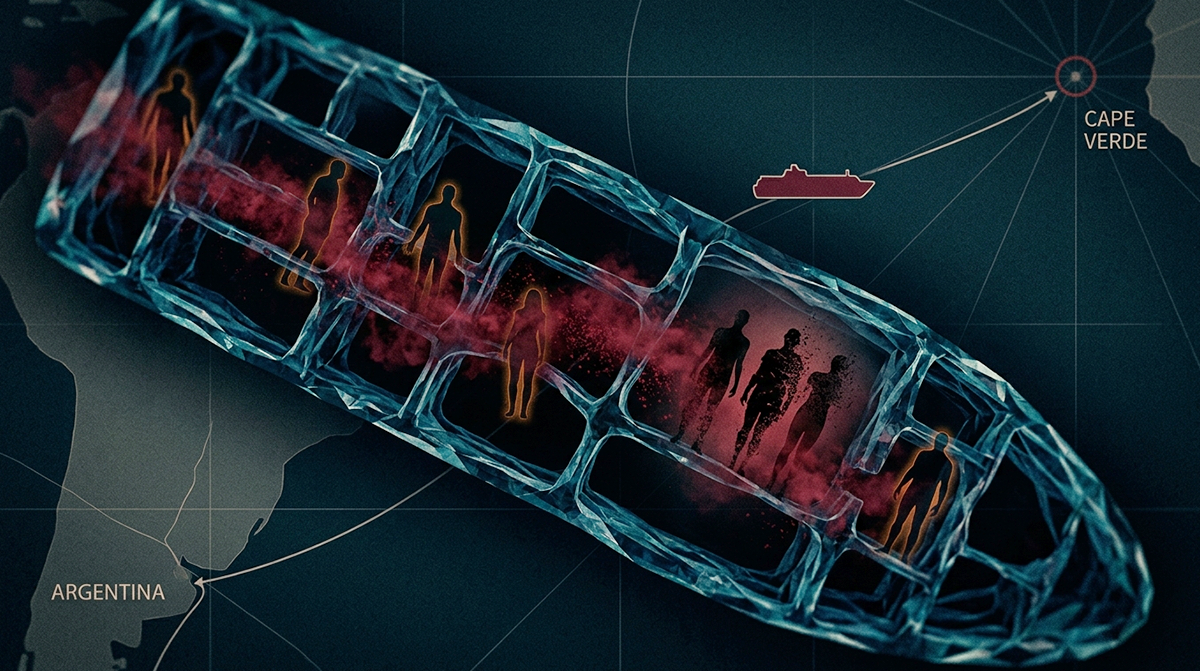
The MV Hondius sits offshore from Cape Verde with 149 passengers on board and nowhere to dock. Three of its travellers are dead. Four others are sick. Two crew members have been airlifted out for urgent medical care, one of them a British national now in intensive care in Johannesburg. The ship sailed from Argentina in early April, and within roughly a week of departure the first case appeared. Local authorities, citing incomplete information about what is moving through the cabins and corridors, have refused permission to disembark. The World Health Organization has confirmed seven cases. The pathogen has been formally identified as hantavirus.
For most readers the name will be unfamiliar. Hantavirus lives, by every textbook account, in rodents. It is not, as a rule, a virus that travels well between people. It is also not a virus that medicine takes lightly when it appears, because the case fatality rate dwarfs almost any respiratory infection in modern memory.
A primer on a viral outlier
Hantaviruses are RNA viruses with rats and mice as their natural reservoirs. Humans are accidental hosts, picking up infection from dust contaminated by rodent urine, droppings, or saliva. Two clinical syndromes describe most severe presentations. The pulmonary form brings fever, cough, and breathlessness, then progresses to fluid-logged lungs that no oxygen mask can fully rescue. The renal form, sometimes called hemorrhagic fever with renal syndrome, brings fever, low platelet counts, protein in the urine, and kidney injury. Both syndromes share a common biological signature, and that signature is what makes the virus so dangerous.
“The main primary disease is damage to the endothelium lining and leakage of fluid out of the blood circulation, and this is why people can get very, very sick,” Dr. Philip McMillan, a clinician and researcher, explains.
The endothelium is a single layer of cells lining every blood vessel in the body, from the great arteries down to the smallest capillaries. When that layer becomes leaky, fluid escapes from the bloodstream into the tissues. In the lungs, the result is pulmonary edema, the medical term for drowning from the inside. In the kidneys, it is filtration failure. Across the body, the blood pressure falls precipitously leading to a condition described in medicine as shock.
The transmission anomaly
The Hondius story departs from textbook hantavirus in one significant way. The virus is not, as a rule, transmissible between people. The single exception in the published literature is the Andes variant, found in Argentina and Chile, which has produced documented person-to-person clusters in South America. Everywhere else, hantavirus exposure is a problem of contaminated environments rather than contaminated people.
That is what makes the cluster aboard the Hondius unusual. There is no reported rodent infestation on the ship. Instead, there is a chain of cases across crew and passengers, with at least three deaths and additional infections requiring evacuation. The pattern looks less like seven travellers who each met the same dust and more like a virus that, after one or more index exposures, found its way from human to human in confined quarters.
The cruise originated in Argentina, which places the Andes variant squarely on the list of working hypotheses. If a passenger or crew member acquired the infection during a stop early in the voyage and then transmitted it onward, the rest of the cluster follows logically. What does not yet follow logically, in any reassuring way, is how readily a virus that should not behave this way appears to be behaving this way.
Why a small cluster matters
Seven cases is a small number in the abstract. Three deaths in seven cases is not.
“If you thought COVID was bad, I think it’s something like 40% mortality with hantavirus,” Dr. McMillan notes.
That figure, in keeping with published case series for severe hantavirus pulmonary syndrome, is what reframes the cluster as a developing global story rather than a local medical curiosity. SARS-CoV-2, even at its most lethal in unvaccinated and untreated populations, never approached this number. A virus that kills two-fifths of recognised cases will, given any meaningful transmission, produce death tolls that respiratory medicine is not configured to absorb.
The mechanism behind the high mortality echoes a pattern medicine has seen recently and at scale. In severe COVID, the worst clinical outcomes were not driven by viral cytotoxicity alone but by an immune response that turned on the body’s own vasculature. The endpoint was the same endothelial dysfunction, the same capillary leak, the same hypoxia. Two viruses, two routes of entry, one shared engine of damage. That convergence is the reason a pathogen primarily known for rodent contact deserves comparison with a respiratory virus that closed the world for two years.
The same convergence is the reason for caution as the inevitable conversation about countermeasures begins. Several research groups have signalled interest in vaccine candidates against hantavirus, including the mRNA platform. The clinical record argues that any such programme should be built on a thorough study of the virus’s pathophysiology rather than on platform assumptions imported from other infections. A vaccine that addresses the wrong target in a disease driven by immune dysregulation can fail quietly at best. The mistakes worth avoiding are knowable in advance, and the work to know them comes first.
The clock that no one wants to think about
The other reason public health officials are watching the Hondius cluster carefully is the incubation period. Symptoms can appear anywhere from one to eight weeks after infection. That is a window long enough for a passenger to disembark, fly home, and develop disease in a country whose clinicians have never seen a case. It is a window long enough for secondary contacts to emerge in Argentina, where the voyage began, weeks after the world’s attention has turned elsewhere. And it is a window long enough for any honest epidemiologist to admit that the case count today tells very little about the case count next month.
Cape Verde’s decision to keep the ship at distance, while the remaining passengers face a possible eight-day onward sail to Las Palmas in the Canary Islands, looks less like overreaction in this light and more like the only reasonable response to a pathogen with a long fuse and a high mortality.
The lesson that keeps returning
What happens next is partly a question of evidence and partly a question of attention. Whether the cluster resolves as a point-source exposure or unfolds as a transmission chain will be visible within weeks. Whether secondary cases appear in Argentina will be visible within months. Whether the first vaccine candidates respect the underlying biology will be visible only over years.
A theme runs through all three timeframes, and it is older than this outbreak. The viruses that kill at scale are rarely the ones that dominate headlines for their virulence in isolation. They are the ones that find a route into the same fragile vascular machinery shared with every other mammal, and exploit it in slightly different ways. SARS-CoV-2 did this through one molecular door. Hantavirus does it through another. The body’s response to both, when the response goes wrong, looks remarkably similar from the bedside.
The MV Hondius may turn out to be a footnote. It may also turn out to be the opening pages of a longer story. Either way, the biology was knowable before the cluster, and remains knowable now. Each time medicine encounters a pathogen that breaks its own rules, the lesson is not that nature is unprecedented. The lesson is that the most important question after the first death is the one that asks why, in pathophysiological terms, this is happening at all. The answers tend to be there, waiting, in the science that was done before anyone was paying attention.

0 Comments